Speech and Signal Processing
Machine Learning and Bioacoustics
Speech and Signal Processing
Machine Learning and Bioacoustics
PhD, Purdue University Electrical and Computer Engineering, August 2000
M.S. in Electrical Engineering, U. Texas at San Antonio, Dec. 1994
B.S. Engineering with EE Concentration, LeTourneau University, April 1990
B.S. Computer Science and Engineering, , LeTourneau University, April 1989
Associate Dean for Undergraduate Education and Student Success, College of Engineering, University of Kentucky. 2023-present
Professor and Chair, Electrical and Computer Engineering, University of Kentucky. 2016-present
Full Professor, Electrical and Computer Engineering, Marquette University. 2013 – 2016.
Director of Graduate Studies, Electrical and Computer Engineering, Marquette University. 2009 – 2012
Associate Professor, Electrical and Computer Engineering, Marquette University. 2007 – 2009
Assistant Professor, Electrical and Computer Engineering, Marquette University. 2000 – 2007
Xu-Kui Yang, Liang He, Dan Qu, Wei-Qiang Zhang, Michael T Johnson, Semi-supervised feature selection for audio classification based on constraint compensated Laplacian score, EURASIP Journal on Audio, Speech, and Music Processing, 1, 2016, 1-10.
Wei-Qiang Zhang, Cong Guo, Qiao Zhang, Jian Kang, Liang He, Jia Liu, and Michael T. Johnson, A Speech Enhancement Algorithm Based on Computational Auditory Scene Analysis. Journal of Tianjin University, in press, 2015.
(Chinese journal. Original language citation: 张卫强,郭璁,张乔,康健,何亮, 刘加,and Michael T. Johnson, 种基于计算听觉场景分析的语音增强算法, 天津大学学报.)
B.T.W. Bochera, K. Cherukurib, J.S. Makib, M. Johnsonc, D.H. Zitomer, Relating methanogen community structure and anaerobic digester function, Water Research, 70 (1), March 2015, 425-435.
PM Scheifele, MT Johnson, M Fry, B Hamel, K Laclede, Vocal classification of vocalizations of a pair of Asian Small-Clawed otters to determine stress, The Journal of the Acoustical Society of America, 138 (1), EL105-EL109, 2015.
Liu Wei-Wei,Cai Meng, Zhang·Wei-Qiang Zhang, Liu Jia, Johnson Michael T., “Discriminative Boosting Algorithm for Diversified Front-End Phonotactic Language Recognition,” Journal of Signal Processing Systems, May 2015.
Trawicki, Marek B. and Johnson, Michael T., “Beta‐order minimum mean‐square error multichannel spectral amplitude estimation for speech enhancement”, International Journal of Adaptive Control and Signal Processing, January 2015.
Arik Kershenbaum, Daniel Blumstein, Marie Roch, Michael T. Johnson, et. al., Acoustic sequences in non-human animals: a tutorial review and prospectus, Biological Reviews, 2014.
C Yu, KK Wójcicki, PC Loizou, JHL Hansen, MT Johnson, “Evaluation of the importance of time-frequency contributions to speech intelligibility in noise”, The Journal of the Acoustical Society of America, vol. 135, no. 5, May 2014, 3007-3016.
Marek B. Trawicki, Michael T. Johnson , “Speech enhancement using Bayesian estimators of the perceptually-motivated short-time spectral amplitude (STSA) with Chi speech priors”, Speech Communication, vol. 57, no. 2, February 2014, pp101-103.
Liu Weiwei, Zhang Weiqiang, Johnson Michael T., Liu Jia, “Homogenous ensemble phonotactic language recognition based on SVM supervector reconstruction”, EURASIP Journal on Audio, Speech, and Music Processing vol. 2014 no. 1, January 2014, pp 1-13.
Junhong Zhao, Wei-Qiang Zhang, Hua Yuan, Michael T Johnson, Jia Liu, Shanhong Xia, “Exploiting contextual information for prosodic event detection using auto-context”, EURASIP Journal on Audio, Speech, and Music Processing, vol. 2013, no. 1, December 2013 pp 1-14.
Marek B. Trawicki, Michael T. Johnson , “Distributed multichannel speech enhancement based on perceptually-motivated Bayesian estimators of the spectral amplitude”, IET Signal Processing, vol. 7, no.4, April 2013, pp. 337-344.
An Ji, Michael T. Johnson, Edward J. Walsh, JoAnn McGee, Doug L. Armstrong, Discrimination of individual tigers (Panthera tigris) from long distance roars, The Journal of the Acoustical Society of America,vol. 133 no. 3, March 2013, pp1762-1769.
Yongzhe Shi, Weiqiang Zhang, Jia Liu, Michael T. Johnson, “RNN language model with word clustering and class-based output layer”, EURASIP Journal on Audio, Speech, and Music Processing vol. 2013 no. 1, January 2013, pp1-7.
Peter M. Scheifele, Michael T. Johnson, David C. Byrne, John G. Clark, Ashley Vandlik, Laura W. Kretschmer, Kristine E. Sonstrom, “Noise impacts from professional dog grooming forced-air dryers”, Noise and Health, vol. 14 no. 60, October 2012, p224-226.
Wen-Lin Zhang, Wei-Qiang Zhang, Bi-Cheng Li, Dan Qu and Michael T. Johnson, “Bayesian Speaker Adaptation Based on a New Hierarchical Probabilistic Model”, IEEE Transactions on Speech and Language Processing, vol. 20 no. 7, July 2012, pp2002-2015.
Yuxiang Shan, Yan Deng, Jia Liu, Michael T. Johnson, “Phone lattice reconstruction for embedded language recognition in LVCSR”, EURASIP Journal on Audio Speech and Music Processing, vol. 2012, no. 15, April 2012, pp1-13.
Marek B. Trawicki, Michael T. Johnson, “Distributed multichannel speech enhancement with minimum mean-square error short-time spectral amplitude, log-spectral amplitude, and spectral phase estimation”. Signal Processing, vol. 92 no. 2, February 2012, pp 345-356.
Peter M. Scheifele, Michael T. Johnson, Laura W. Kretschmer, John G. Clark, Deborah Kemper, Gopu Potty, “Ambient habitat noise and vibration at the Georgia Aquarium”, The Journal of the Acoustical Society of America, vol. 132 no. 2, February 2012, EL88-EL94.
EGR 101 Engineering Exploration 1
Engineering Exploration I introduces students to the creativity inherent to how engineers approach innovation, design and problem solving from blue sky brainstorming to implementing a solution. Students in this course are introduced to a wide variety of engineering disciplines, skills, and career opportunities and are introduced to engineering design and critical thinking processes.
UK 101 Academic Orientation
Academic Orientation introduces strategies and resources that build a strong foundation for academic success while promoting opportunities for intellectual and personal growth. The student learning outcomes address specific issues of student transition, focusing on the purpose and challenges of a college education, developing learning strategies and study skills, promoting student engagement, and increasing knowledge of campus resources.
EGR190 Understanding Leadership
This course is an introduction to the principles and practice of engineering leadership. Topics include defining leadership, characteristics of a leader, leadership models, trust and ethics, emotional intelligence, effective communication, and change management. Through this course students will build an understanding of what leadership is and begin the process of developing their own personal leadership style, goals, and plan.
EE 211 Circuits 1
This course provides and introduction to fundamental laws, principles and analysis techniques for DC and AC linear circuits whose elements consist of passive and active components used in modern engineering practice including the determination of steady state and transient responses.
EE 421 Signals and Systems
This course provides an introduction to continuous and discrete signal and system models and analyses. Topics include discrete and continuous convolution, Fourier transforms, and Laplace transforms and Z-transforms with application examples including AM modulation and the sampling theorem.
EE 422 Signals and Systems Laboratory
This course is a hands-on laboratory course where students apply the concepts of signals and systems to problems in signal processing, communications, and control systems. Topics include noise models, filter design, modulation techniques, sampling, discrete Fourier Transforms, state variable models, and feedback design with an emphasis on using computer software for analysis and simulation.
EE 599 Topics in EE: Speech Processing
This course provides an introduction to the fundamentals of speech processing, including speech production and perception, speech analysis and representation, and applications to speech coding, synthesis, recognition, and language modeling.
EE 630 Digital Signal Processing
This course is a graduate-level introduction to digital signal processing. Topics include frequency domain analysis of signals using Fourier and Z Transforms, sampling and reconstruction theory, filter design and implementation, multirate signal processing linear prediction and optimal filter theory, adaptive signal processing, and power spectral estimation.
EECE 1953 and EECE 1954 ECE Freshman Seminar
This is an introduction to electrical engineering and computer engineering. Organized around the Roomba platform from iRobot, this course gives students an opportunity to learn problem solving, develop and carry out team projects, and interact with their peers and other members of the EECE Department.
EECE 2030 Digital Electronics
This course introduces students to the basic principles of digital circuit analysis and design. Topics covered include: Boolean Algebra, number systems, basic logic gates, standard combinational circuits, combinational design, timing diagrams, flip-flops, sequential design, standard sequential circuits and programmable logic devices.
EECE 4510 Digital Signal Processing
This course is an introduction to discrete-time signals and systems.Topics include sampling theory and linear time invariant system analysis through convolution, Fourier transforms and z-transforms. In addition, techniques for the design of digital filters are introduced, and the computation and use of the discrete Fourier transform and fast Fourier transform is discussed. Applications of these concepts is accomplished through several Matlab-based design projects.
EECE 6510 Optimal and Adaptive Digital Signal Processing
This course is an introduction to optimal and adaptive signal processing techniques, including spectral estimation, Wiener filters, linear prediction, steepest descent and least mean square algorithms, least squares and recursive least squares estimation, and Kalman filters.
EECE 6520 Digital Processing of Speech Signals
This course is an introduction to the fundamentals of speech processing, including speech production models and feature analysis, with applications in speech coding, synthesis, and recognition.
COEN 4710 Computer Hardware
This course is an overview of computer hardware systems, with emphasis on microprocessor design. Topics include performance analysis, MIPS assembly language, arithmetic logic units, datapath and control aspects of instruction set architectures, pipelining, and memory and I/O devices.
EECE 113 (EECE3020) Linear Systems Analysis
This course introduces mathematical concepts of continuous-time signals and systems. The time-domain viewpoint is developed for linear time invariant systems using the impulse response and convolution integral. The frequency domain viewpoint is also explored through the Fourier Series and Fourier Transform, and basic filtering concepts are discussed. The sampling theorem, the Z-transform, and the Discrete Fourier Transform are also introduced.
COEN 140 (COEN 4720) Embedded Systems Design
This course introduces students to embedded systems, the types of hardware that can support such systems, and the interfacing used in embedded systems. The course is a combined laboratory and lecture course, which directly applies the embedded systems techniques using hardware description and assembly languages to field programmable gate array technology.
EECE 214 Information and Coding Theory
This course is an introduction to information measure, mutual information, self-information, entropy, encoding of information, discrete and continuous channels, channel capacity, error detection, error correcting codes, group codes, cyclic codes, BCH codes, convolution codes, and advanced codes.
EECE 211 (EECE 6810) Algorithm Analysis and Applications
This course is an introduction to the analysis of algorithms. Topics covered include asymptotic complexity notation, recursion analysis, advanced data structures, sorting methodologies, dynamic programming, graph algorithms, and an introduction to several advanced topics such as NP-completeness theory and linear programming.
EECE 6830 Pattern Recognition
This course is an introduction to the theory and application of statistical pattern recognition, hypothesis testing, and parameter estimation. Topics include probability distribution models, Bayesian decision theory and hypothesis testing, classical and modern approaches to parameter estimation, parametric and non-parametric classifiers. Also covered are diagonalization and the Karhunen-Loeve transform (a.k.a. Principal Components analysis), supervised and unsupervised clustering, Expectation Maximization algorithms for Maximum Likelihood estimation, and linear discriminant analysis.
Digital Signal Processing
This course is an introduction to discrete-time signals and systems. Topics include sampling theory and linear time invariant system analysis through convolution, Fourier transforms and z-transforms. In addition, techniques for the design of digital filters are introduced, and the computation and use of the discrete Fourier transform and fast Fourier transform is discussed. Applications of these concepts is accomplished through several Matlab-based design projects.
Statistical Pattern Recognition
This course is an introduction to the theory and application of statistical pattern recognition, hypothesis testing, and parameter estimation. Topics include probability distribution models, Bayesian decision theory and hypothesis testing, classical and modern approaches to parameter estimation, parametric and non-parametric classifiers. Also covered are diagonalization and the Karhunen-Loeve transform (a.k.a. Principal Components analysis), supervised and unsupervised clustering, Expectation Maximization algorithms for Maximum Likelihood estimation, and linear discriminant analysis.
Professional Research Writing
This course focuses on scientific writing in English. The central focus is content and organization of manuscripts for submission to international scientific journals. In addition, a wide variety of other types of professional writing are discussed, including the GRE analytical writing question, the TOEFL and TWE writing tests, and writing resumes and personal statements.
Electro-Magnetic Articulography (EMA) has been a rapidly growing technology for accurate measurement of articulatory kinematics. This technology is based on measuring the induced current caused by motion of encapsulated miniature toroid coils in a system of electromagnetic fields.
The Marquette Speech and Swallowing Lab, directed by Professor Jeffrey Berry, has an EMA Wave System manufactured by Northern Digital, Inc. Our NDI Wave system captures both position and orientation at a sampling rate of up to 400 Hz, with position error on the scale of +/- 0.5mm. A single sensor captures 5 Degree of Freedom (DOF) information, including 3 dimensional position information plus the 2-dimensional orientation of the sensor plane. A 6 DOF sensor can be constructed using dual non-planar coils to capture full orientation information.
The simultaneous acoustic and articulatory kinematic data collected via this system is used to pursue research on a range of topics, including:
We have several National Science Foundation funded projects related to this EMA work. These projects include:
EAGER: Acoustic-Articulator Modeling for Pronunciation Analysis, NSF IIS-1142826 (Dataset web page: EMA-MAE: EMA database of Mandarin-Accented English)
In order to support effective learning and provide specific, useful pronunciation feedback to users, Computer Aided Language Learning (CALL) systems for pronunciation correction must be able to capture pronunciation errors and accurately identify and describe errors in articulation. To do this, it is necessary to estimate articulator trajectory patterns from users’ acoustic data. Due to the difficulty of acoustic-articulator inversion and the complexities of inter-speaker differences in articulator patterns, this capacity is not yet well developed. Current systems are limited in the specificity of the corrective feedback that is provided, often only providing a “good versus bad” pronunciation match to the target and even at best only providing the general category of pronunciation error. This project, funded by the NSF through the EAGER program, aims to address these key limitations through collection of a matched acoustic and five degree of freedom electromagnetic articulograph (EMA) data corpus for both native American English (L1) speakers and native Mandarin Chinese (L2) speakers who speak English as a second language. This has potential to be used for a variety of research efforts, including areas such as pronunciation variation modeling, acoustic-articulator inversion, L2-L1 speaker comparisons, pronunciation error detection, and corrective feedback for accent modification.
RI: Small: Speaker Independent Acoustic-Articulator Inversion for Pronunciation Assessment, NSF IIS-1320892
This project addresses the problem of robust speaker-independent acoustic-to-articulator inversion, with a focus on pronunciation assessment applications. Acoustic-to-articulator inversion, the estimation of articulatory trajectories from an acoustic signal, is a challenging problem due to the complexity of articulation patterns and significant inter-speaker differences, and is even more so when applied to non-native speakers without any kinematic training data. We propose to address this problem through development of a robust normalized working space for articulatory representation and use of a novel speaker-independent inversion approach called Parallel Reference Speaker Weighting (PRSW), which uses parallel acoustic-articulator adaptation to create speaker-specific models for new speakers without any kinematic training data. The approach will be evaluated on our newly developed acoustic / 3-D electromagnetic articulography (EMA) dataset of native American English (L1) speakers and native Mandarin Chinese (L2) speakers who speak English as a second language.
There is a significant need for more comprehensive electromagnetic articulography (EMA) datasets that can provide matched acoustics and articulatory kinematic data with good spatial and temporal resolution. The Marquette University Electromagnetic Articulography Mandarin Accented English (EMA-MAE) corpus provides kinematic and acoustic data from 40 gender and dialect balanced speakers representing 20 Midwestern standard American English L1 speakers and 20 Mandarin Accented English (MAE) L2 speakers, half Beijing region dialect and half are Shanghai region dialect. Three dimensional EMA data were collected at a 400 Hz sampling rate using the NDI Wave system, with articulatory sensors on the midsagittal lips, lower incisors, tongue blade and dorsum, plus lateral lip corner and tongue body. Sensors provide three-dimensional position data as well as two-dimensional orientation data representing the orientation of the sensor plane. Data have been corrected for head movement relative to a fixed reference sensor and also adjusted using a biteplate calibration system to place the data in an articulatory working space relative to each subject’s individual midsagittal and maxillary occlusal planes. Speech materials include isolated words chosen to focus on specific contrasts between the English and Mandarin languages, as well as sentences and paragraphs for continuous speech, totaling approximately 45 minutes of data per subject.
The EMA-MAE dataset was collected in Marquette’s Speech and Swallowing Lab, directed by Professor Jeffrey Berry, using an NDI Wave System.
See the following publication for more details:
The EMA-MAE dataset is currently available to researchers in this area. Please email Dr. Mike Johnson to request a copy of the data.
My research interests include a broad range of topics related to speech, signal processing, and language. In recent years, this has included the following topic areas:
In collaboration with Dr. Jeff Berry of Speech Pathology and Audiology
In collaboration with numerous collaborators in the field of bioacoustics.
In collaboration with Dr. Richard Povinelli
I also have a close research collaboration with Tsinghua University and Professor Jia Liu,
and have worked with their research group on several speech projects
What are the Odds of a Perfect Bracket in the NCAA tournament?

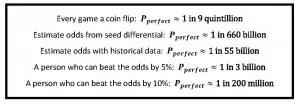
Interested in the math behind this? You may want to check out my colleague Jeff Bergen‘s Youtube video on his estimate of these odds (128 billion to 1).